
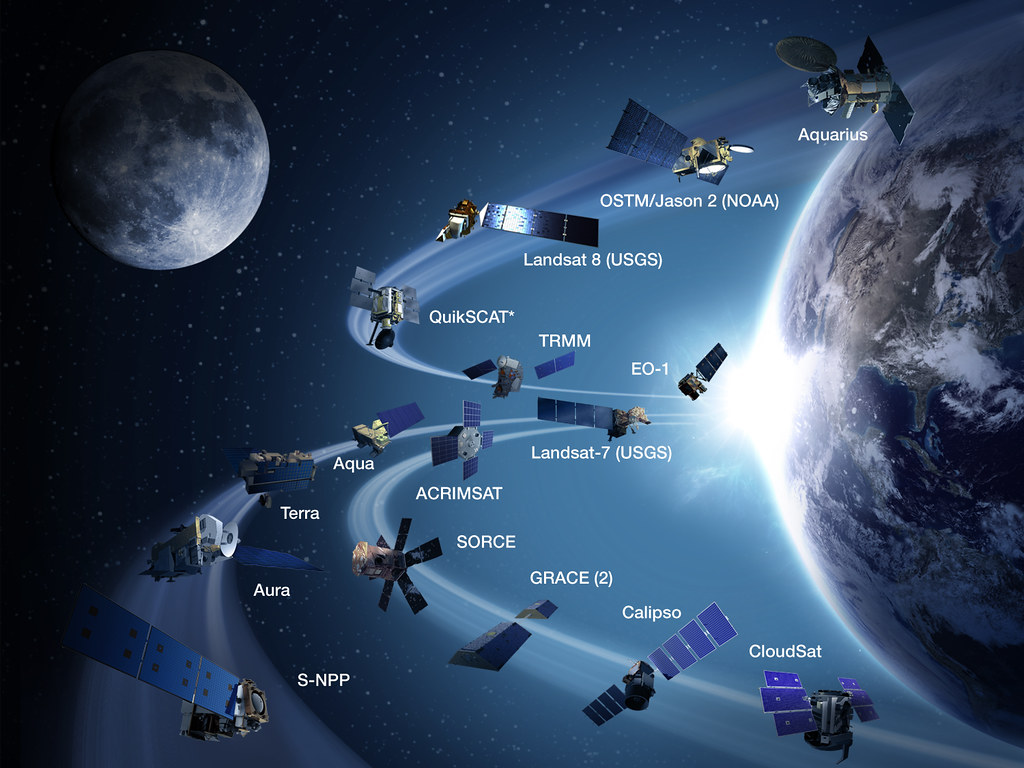
A satellite orbits the Earth without falling into it due to a balance between the gravitational force pulling it inward and its forward velocity. This balance is maintained through the principle of centripetal force and the concept of orbital mechanics. Here’s a simplified explanation:
- Gravitational Force: The Earth’s gravity pulls objects toward its center. The force of gravity decreases with distance but is still significant at the altitude where satellites orbit.
- Centripetal Force: Centripetal force is the force that pulls an object toward the center of a circular path. In the case of a satellite, it is the force that keeps it in orbit. The centripetal force required for the satellite’s orbit is provided by the gravitational force.
- Forward Velocity: Satellites are launched into space with enough horizontal velocity to counteract the pull of gravity. This velocity allows them to continually fall toward the Earth but also move forward fast enough that they keep missing it.
- Balance of Forces: When a satellite is launched into its orbit, the forward velocity is precisely calculated to create a balance between the gravitational force pulling it inward and the centripetal force pulling it outward. This balance ensures that the satellite follows a stable and continuous orbit.
- Newton’s Laws of Motion: Newton’s laws, specifically the first and second laws of motion, govern the behavior of objects in space. The first law states that an object in motion stays in motion with the same speed and direction unless acted upon by an external force. The second law explains the relationship between force, mass, and acceleration.
- Conservation of Angular Momentum: Satellites also maintain their orbits through the conservation of angular momentum. Angular momentum is a property that depends on an object’s mass, velocity, and distance from the center of rotation. By maintaining a specific distance and velocity, the satellite’s angular momentum remains constant, ensuring its stability in orbit.
Overall, a satellite stays in orbit around the Earth by balancing the gravitational force pulling it inward and its forward velocity. This delicate balance allows the satellite to continuously fall toward the Earth but also move forward at a sufficient speed to remain in orbit without falling into the planet.
 Express your opinion with A to Z write